

New Issue + Excerpt: To Be a Father in a Time of Annihilation
Dispatch # 40 | Join us on 19 November at Ibraaz for the launch of Translator Issue #2: a celebration of journalistic pluralism, language and the many voices beyond the Anglosphere
Hello and welcome to Translator’s 40th Dispatch.
Since January 2025, we’ve published 146 summaries spanning over 65 countries and 38 languages. At a time when much of the Anglophone media flattens the world, Translator seeks out stories and perspectives that reveal its richness – offering a portal into multiple media landscapes.
This week marks a milestone in that mission: the launch of Translator Issue #2. As with our weekly Dispatches, the new print issue issue starts where stories are already being written and spoken about: in magazines, in newspapers and on street corners around the world. Inside, you’ll find more pages, more Street Talks, and more translated reportage and essays – from Palestine, Japan, Brazil, Belgium and beyond.
We’re so excited to be celebrating the launch of Issue #2 on Wednesday 19 November in London with an event at Ibraaz – a brave new space for art, culture and ideas from the Global Majority. Just as Translator seeks to illuminate stories that might otherwise go unseen, Ibraaz is rooted in cultural pluralism and the exchange of ideas across borders. Its name – derived from the Arabic phrase ‘to shine a light on’ – perfectly captures what both of us strive to do: amplify the many voices beyond the Anglosphere.
The evening will bring together our editors Charles Emmerson, Trà My Hickin and Zanta Nkumane, alongside Karachi-based journalist Sanam Maher and New Delhi-based photographer and Issue #2 contributor Ishan Tankha (joining by video). We’ll also share the voices of our contributors on the cinema screen of Ibraaz’s Minassa (Arabic for ‘platform’), gathering around a shared desire to read the world differently. We’d love to see you there – book your free ticket here.
As ever, our hope is to create a space – in print, in conversation and online – where language is a bridge, not a barrier. Issue #2 is a celebration of that belief, and of the storytellers – writers, illustrators, designers, publishers, cultural platforms like Ibraaz, translators of all kinds – who make it possible.

Of course, our deepest gratitude goes to you, our readers. As a thank you for joining us on this journey, we wanted to share the opening of one of the most powerful pieces in the new issue of Translator – an extraordinary essay by Palestinian writer and editor Muhammad al-Zaqzouq, originally published in Arabic by 7iber and translated into English by Nour Jaljuli.
‘To Be a Father in a Time of Annihilation’ is a meditation on what it means to parent amid destruction. Al-Zaqzouq reflects on the inheritance of fear and the impossible weight of protection in Gaza, where fatherhood is both an ethical and existential act.
With striking clarity and restraint, the piece captures the dissonance of trying to shield one’s children from a world collapsing around them and, ultimately, a portrait of love stretched to its limits, that continues to hold.
We hope you enjoy this excerpt.

To Be a Father in a Time of Annihilation
Palestinian writer and editor Muhammed al-Zaqzouq writes about how the war in Gaza has reshaped the concept of fatherhood for him and his children
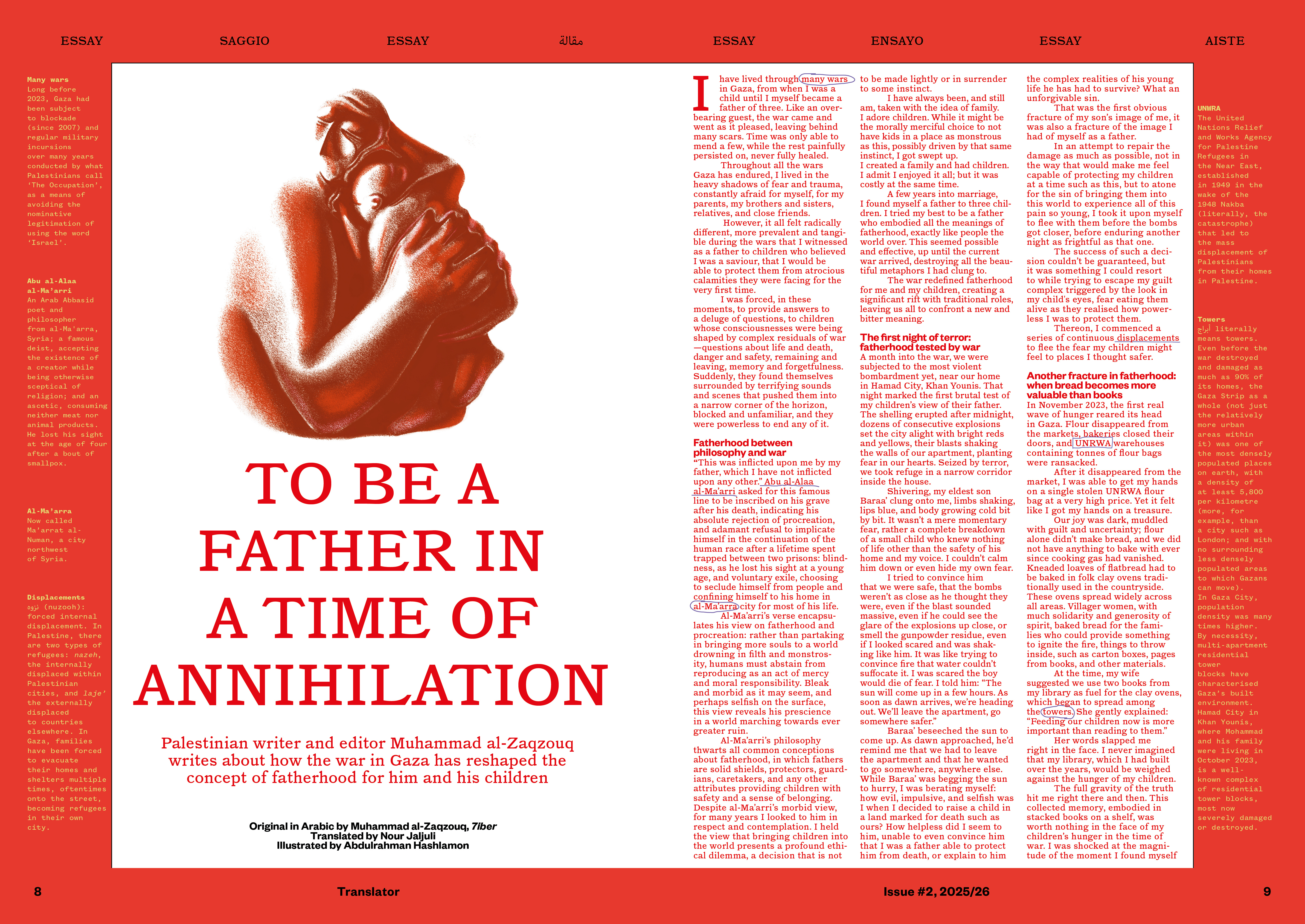
I have lived through many wars in Gaza, from when I was a child until I myself became a father of three. Like an overbearing guest, the war came and went as it pleased, leaving behind many scars. Time was only able to mend a few, while the rest painfully persisted on, never fully healed.
Throughout all the wars Gaza has endured, I lived in the heavy shadows of fear and trauma, constantly afraid for myself, for my parents, my brothers and sisters, relatives, and close friends.
However, it all felt radically different, more prevalent and tangible during the wars that I witnessed as a father to children who believed I was a saviour, that I would be able to protect them from atrocious calamities they were facing for the very first time.
I was forced, in these moments, to provide answers to a deluge of questions, to children whose consciousnesses were being shaped by complex residuals of war – questions about life and death, danger and safety, remaining and leaving, memory and forgetfulness. Suddenly, they found themselves surrounded by terrifying sounds and scenes that pushed them into a narrow corner of the horizon, blocked and unfamiliar, and they were powerless to end any of it.
Fatherhood between philosophy and war
“This was inflicted upon me by my father, which I have not inflicted upon any other.” Abu al-Alaa al-Ma’arri asked for this famous line to be inscribed on his grave after his death, indicating his absolute rejection of procreation, and adamant refusal to implicate himself in the continuation of the human race after a lifetime spent trapped between two prisons: blindness, as he lost his sight at a young age, and voluntary exile, choosing to seclude himself from people and confining himself to his home in al-Ma’arra city for most of his life.
Al-Ma’arri’s verse encapsulates his view on fatherhood and procreation: rather than partaking in bringing more souls to a world drowning in filth and monstrosity, humans must abstain from reproducing as an act of mercy and moral responsibility. Bleak and morbid as it may seem, and perhaps selfish on the surface, this view reveals his prescience in a world marching towards ever greater ruin.
Al-Ma’arri’s philosophy thwarts all common conceptions about fatherhood, in which fathers are solid shields, protectors, guardians, caretakers, and any other attributes providing children with safety and a sense of belonging. Despite al-Ma’arri’s morbid view, for many years I looked to him in respect and contemplation. I held the view that bringing children into the world presents a profound ethical dilemma, a decision that is not to be made lightly or in surrender to some instinct.
I have always been, and still am, taken with the idea of family. I adore children. While it might be the morally merciful choice to not have kids in a place as monstrous as this, possibly driven by that same instinct, I got swept up. I created a family and had children. I admit I enjoyed it all; but it was costly at the same time.
A few years into marriage, I found myself a father to three children. I tried my best to be a father who embodied all the meanings of fatherhood, exactly like people the world over. This seemed possible and effective, up until the current war arrived, destroying all the beautiful metaphors I had clung to.
The war redefined fatherhood for me and my children, creating a significant rift with traditional roles, leaving us all to confront a new and bitter meaning…
This excerpt is taken from Translator Issue #2, out on 20 November. To read on, pre-order a copy of the magazine here.

Original article ‘أن تكون أبًا في زمن الإبادة’ by Muhammed al-Zaqzouq was published in Arabic by 7iber on 22 May 2025.
It is available here.
7iber is an Amman-based media organisation and online magazine publishing in-depth multimedia journalism, critical analysis and public conversation.


Translator Issue #2 expands our journey beyond the Anglosphere, bringing together an even wider network of contributors from around the world and wonderful art direction and design by magCulture Studio. Inside, you’ll find:
STREET TALK: Hyperlocal stories from Belfast, Dublin, Jakarta, Hanoi, Guadalajara and Yakutsk, by Séamus Branch, Ana Kinsella, Sabrina Citra, Kiều-Anh Nguyễn, Nicolás Kouzouyan and Natalya Khokholova. Illustrated by Elio Ferrario.
ESSAY: From 7iber, Palestinian writer and editor Muhammad al Zaqzouq on fatherhood under siege in Gaza. Translated by Nour Jaljuli. Illustrated by Abdulrahman Hashlamon.
FEATURE: From NRC, Dutch reporters Esther Rosenberg, Nina Stefanovski, Ilse Eshuis and Bram Endedijk trace the trade in laughing gas. Translated by Brendan Monaghan.
FEATURE: From Repórter Brasil, Diego Junquiera investigates the landmark case accusing Volkswagen of enslaving hundreds of rural workers in the Amazon. Translated by Julia Sanches.
REPORT: From Svenska Dagbladet, Henning Eklund uncovers the bitter power struggles behind the soaring profits of Sweden’s publishing giants. Translated by Kate Lambert. Illustrated by Tori McGuire.
PHOTO ESSAY: In ‘Six Days in September’, Indian photojournalist Ishan Tankha reports from Kathmandu in the wake of the Gen Z protests.
ESSAY: From L’Indiscreto, Rosalba Nodari’s article explores how language determines truth and power in Italian law. Translated by Antonella Lettieri. Illustrated by Marina Songserm.
REPORT: From Nawaat, Najla Ben Salah on how waste from Tunisia’s fertiliser industry has poisoned the southern coastline – and the movement fighting back. Translated by Fatima Zohra Krimou. Illustrated by Daria Chernyshova.
FEATURE: From Píaui, José Henrique Bortoluci interviews an evangelical preacher on his journey from the world of crime to the kingdom of Jesus. Translated by Rahul Bery.
FEATURE: From Chihei, Misa Koyama traces atomic legacies from Hiroshima to Kazakhstan. Translated by Allison Markin Powell. Illustrated by Yaya.
FEATURE: From Médor, Chloé Andries searches Belgium’s secondhand shops for forgotten treasures. Translated by Charles Emmerson. Photography by Thomas Fretuer.
REVIEW: Fairuza Hanun reads Annah, Infinite by Khairani Barokka, a translation of a famous painting – into a book.
ANALYSIS: In Read Between the Lines, writer, journalist and Translator contributing editor Jessie Lau explores local coverage of the ‘Mask Park incident’ and state narratives in China.
CROSSWORD: Translator’s second multilingual crossword, put together by Beatrice Barr. If you’re first to complete it, we’ll give you a free subscription to Translator for a year!

That’s all for now – we hope you’ve enjoyed the read. Keep an eye out for our next Dispatch of summaries this time next week!
The Translator team