

New event: Translating the Environment + stories from India, Brazil and France
DISPATCH №67
Hello and welcome.
We’re pleased to share that our next in-person event, The World Overheard 2: Translating the Environment, is taking place at Ibraaz in London on Wednesday June 17 from 6-8pm.
The second instalment in this series asks how environmental crises are reported around the world – and whose crisis gets narrated, in which language, and for whom?
Book your free spot below and forward this email to a friend to invite them along too!
Many thanks as well to those that have already shared their feedback on the future of Translator – we’ve loved reading your responses so far.
If you haven’t yet, please do share your thoughts with us before June 5 – we’ll then enter you into a draw to win a free print magazine and a tote bag for you and a friend.


Now, on to the Dispatch.

When satire becomes unsafe in India
The parents of a Gen-Z icon fear for his safety after a government crackdown on his new cockroach-inspired political party
A new political party in India, the Cockroach Janata Party (CJP), has made international news headlines this week not only as a satirical response to the Chief Justice of India’s recent comments comparing unemployed young Indians to “cockroaches”, but also for the response it has provoked from Prime Minister Narendra Modi’s ruling party.
The Navbharat Times, a Hindi newspaper in India, reports that the CJP founder Abhijit Dipke’s parents are increasingly concerned about his safety after the government blocked the CJP’s X account, its Instagram was targeted by unknown hackers, and Dipke began receiving death threats on WhatsApp. In India, interviewing the parents of young people in the news, whether they are protestors, assault victims or rising celebrities is a common practice, as is reporting on their academic performance at school. A common question used to chastise young people loitering in India is: “What do your parents think of what you are doing?”
Dipke’s father Bhagwan told reporters “I can’t sleep because I am so worried about my son. I hate politics, and I just want him to stay safe.” His mother Anita said she’d like her son to stay away from politics entirely (he was previously a political communications strategist for a different Indian political party). She also said she thinks it’s unlikely that her son would do as his parents desired; she told the newspaper that he was studying to be an engineer, but found the subject “too difficult” and turned to journalism. He currently lives in Boston.
Some political observers say that the CJP’s soaring online popularity, particularly among Gen-Z Indians, is a notable expression of dissent that is reminiscent of recent student and youth-led uprisings and political revolutions across South Asia including in Bangladesh, Sri Lanka, Indonesia and Nepal. Since its creation earlier this month, the CJP has amassed more followers on social media than the far right Hindu nationalist BJP, which has been in power since 2014. The government is known for harsh crackdowns on student protestors, often keeping them imprisoned for years without trial or bail. It’s no wonder then that Dipke’s parents are losing sleep.
Dipke has challenged the block of the CJP’s X account in a Delhi court and the party is now also the subject of a public interest lawsuit. Dipke and his parents have expressed concern that he could be arrested at an Indian airport and taken straight to Tihar, India’s largest prison complex, upon returning to his home country.
The Indian government has not yet made an official statement about the CJP.
The original articles ‘कॉकरोच जनता पार्टी के खिलाफ सुप्रीम कोर्ट में याचिका, जानें कौन-कौन से लीगल एक्शन लेने की उठी मांग’ and ‘हम बेटे को राजनीति में नहीं चाहते... ‘कॉकरोच जनता पार्टी’ वाले अभिजीत दीपके के माता-पिता को आखिर किस बात का डर’ appeared in Hindi The Navbharat Times on May 24 and May 22, respectively.
The Navbharat Times is a Hindi newspaper distributed in Delhi, Mumbai, Lucknow and Kanpur.
Summary by Nishita Jha

Dialogue with the dolls
Brazil moves to recognise trans language Pajubá as cultural heritage
In the hidden cracks of Brazilian society, where queer communities continue to resist erasure, a secret language is flourishing. Pajubá, once considered “the language of criminals” because of its use by the queer community to resist police repression during Brazil’s military dictatorship (1964-85), is a shared code that serves to identify and protect the trans community. It signals that “If you speak like me, you are like me.” Now, a language that emerged from a history of exclusion could be preserved and formally recognised as an intangible piece of queer heritage, according to a report by Brazilian investigative journalism outlet, Agência Pública.
On October 20, 2025, the National Association of Transvestites and Transsexuals (ANTRA) filed a landmark request with the National Institute of Historical and Artistic Heritage (IPHAN), the federal government’s agency responsible for preserving, protecting and promoting the country’s cultural and historical heritage. ANTRA is seeking the recognition of Pajubá as an Intangible Cultural Heritage of Brazil, which would protect it alongside the Capoeira martial art, Samba dance and other festivals, music and art forms.
In an interview with Agência Pública, the writer, professor and trans activist Amara Moira says Pajubá is “a language of protection and identity”. She shares how Pajubá holds the keys to queer history in Brazil, which is deeply rooted in Afro-Brazilian and African religious traditions. “The language is born from this segregated life, from this exclusion, and it transforms itself all the time.”
According to the article, one of the first acts of the 1990s trans rights movement in Brazil was the creation of a dictionary, Diálogo de Bonecas (Doll Dialogue), by Jovanna Baby – one of the most celebrated trans activists in Brazil.
The dictionary was an inspiration to Moira, whose book Neca: A Novel in Pajubá, is intended as an encyclopaedia of trans knowledge. She explains that the inspiration for her book came from living and working in Jardim Itatinga, an area in the city of Campinas, São Paulo, that is home to many trans people and sex workers. She spent her formative years here, began her transition and worked as a sex worker.
Moira’s research initially drew from conversations with friends, but she says it developed further when she discovered dictionaries and ancestral records of “queer language”.
Responding to questions on whether a book or a dictionary would expose the Pajubá language and threaten the trans community, Baby and Moira agree that no one can learn the language from a book. In fact, attempting to do so will probably be met with ridicule, Moira says. Instead, she describes it as a “metamorphic” language with “little-known encryption strategies” that ensure the protection and secrecy of all those that speak it.
Amid widespread attacks and political violence on trans communities worldwide, the preservation and recognition of Pajubá could signal a new dawn for trans communities in Brazil. Moira believes that drawing attention to the language will help create other tools and strategies for its survival.
“Writing in Pajubá, for me, was the only possible way to tell this story. There was no other language capable of conveying what I wanted to say.”

The original article ‘Pajubá: linguagem, proteção e resistência’ by Andrea DiP, Sofia Amaral, Ricardo Terto and Stela Diogo was first published in Portuguese by Agência Pública on 14 December 2025.
Agência Pública is Brazil’s first investigative journalism agency, dedicated to public interest reporting with a focus on human rights, democracy and social justice.
Summary by Trà My Hickin
From hand to eye to mouth to ear
Amongst the deaf of Egypt’s Sinai peninsula
Fingertips pressed together in a twisting motion to indicate “lemon”; an energetic motion of both wrists to say “bread”, suggestive of how flatbread dough would be thrown into the hot embers of a desert fire to cook; a hand drawn across the cheek to indicate “man”, on the presumption that all men have beards. These are just some of signed words used by a single Bedouin tribe in Egypt’s Sinai peninsula, the triangle of desert and mountain that marks the meeting point of Africa and Asia, the Suez on one side of the peninsula, the Gulf of Aqaba on the other.
In a fascinating article for Usbek and Rica, Jenna le Bras explores lokha torsh (the local name for the sign language) as a phenomenon deeply anchored in Bedouin society – both shaped by its culture and shaping it in turn.
The first written record of the sign language’s existence crops up in travellers’ accounts from a few centuries ago. But in terms of scientific work on the language, lokha torsh is essentially newly discovered. An Israeli academic who has coined the name ABSL (Al-Sayyid Bedouin Sign Language) for the signed language used by Bedouin in the Negev desert – outside Egypt – cautions against imagining lokha torsh and ABSL as mere variations of each other. Some signs are similar; others are completely different. “It would take years of study on the ground” to even begin to understand the language’s origins and interconnections, she says.
There is a particular practical reason for the prevalence of lokha torhsh in Egyptian Sinai. Over time, marriage between cousins has tended to re-enforce genetic traits rather than dilute them. Rates of hereditary deafness are extremely high.
“Blood ties are important for us Bedouin,” explains Mohamed, one of those interviewed in the article, himself a deaf man of 40. Mohamed’s grandfather and uncle were deaf before him. He is now married to Husseina, his uncle’s daughter. The article begins with Mohamed and Husseina’s deaf child Salah complaining of a buzzing sensation in his ears. His parents rush to a local doctor hoping the call of the muezzin has miraculously awakened their child’s hearing – only to discover it’s an insect trapped in his ear.
As he is being interviewed, Mohamed’s mobile rings. He passes it to his wife, who acts as translator between the spoken word she can hear, and her husband signing his responses, arranging the logistics for a tourist trip. It’s an intimate scene. But le Bras draws out a larger point about how deafness is treated in Bedouin society: the sense of solidarity – she cites the Arabic term aṣabiyyah – which means it is common for deaf and non-deaf to be paired up, in both familial and professional situations, as needed.
Taking tourists out into the desert Mohamed is paired up with non-deaf Brahim. It’s a multilingual context: often English, sometimes Russian, sometimes Hebrew. “We are all used to working in several languages,” Brahim explains: “so I barely count lokha torsh as extra.”
On the first night of Ramadan, le Bras observes a vibrant conversation amongst members of Mohamed’s family as part of the festivities. “And yet,” she writes, “it all takes place in near silence. Stifled laughter, barely aspirated syllables….”. Many young people have smartphones. But their interactions on Tik Tok or other social media are mostly through emojis.
At the local school, 60 kilometres away, there has been a class for deaf children since 2017. It hasn’t been easy. When she first arrived, the new teacher found the textbooks had turned to dust. The sign language she had learned was classical Arabic rather than Bedouin. Even now, only five children regularly attend. “Formal education isn’t a priority” amongst the Bedouin, the article explains.
Then there was the time a charitable association decided to distribute hearing aids locally. Hundreds of hearing tests were done. Gilly, a retired British ballerina, drove to Cairo to order the aids. “It was fantastic,” she says, “we felt part of something useful.” But the aids were never worn. Emira, a local social worker, admits it was naïve to imagine turning up with a whole bunch of new gizmos would change things: “we should have stayed by their [the locals’] side… proposed hearing therapies.” The list of those who got the hearing aids bears a familiar name: Mohamed, husband of Husseina.
They are still there, in Mohamed and Husseina’s home, packed safely in a box. Why weren’t they used? The noise was too much for Mohamed, his wife explains. As for the children, wouldn’t they just have broken, or filled with dust? What language would they be expected to speak, anyhow?
The article concludes, powerfully, on the perspective involved. What the association imagined as a miraculous technological solution to the problem of deafness was viewed by others as an answer to a problem which didn’t exist. “Why complicate life when we have no problem communicating anyhow?” Husseina says.
Language, after all, takes many forms.
The original article ‘Sur les traces d’une nouvelle langue des signes née au cœur du Sinaï’ by Jenna Le Bras was first published by Usbek & Rica in French in their Futur magazine in 2024 and republished online on March 10, 2026. It was a finalist for the 2026 True Story award.
Usbek & Rica is a French language publication oriented towards writing about the future. You can also read its manifesto.
Summary by Charles Emmerson

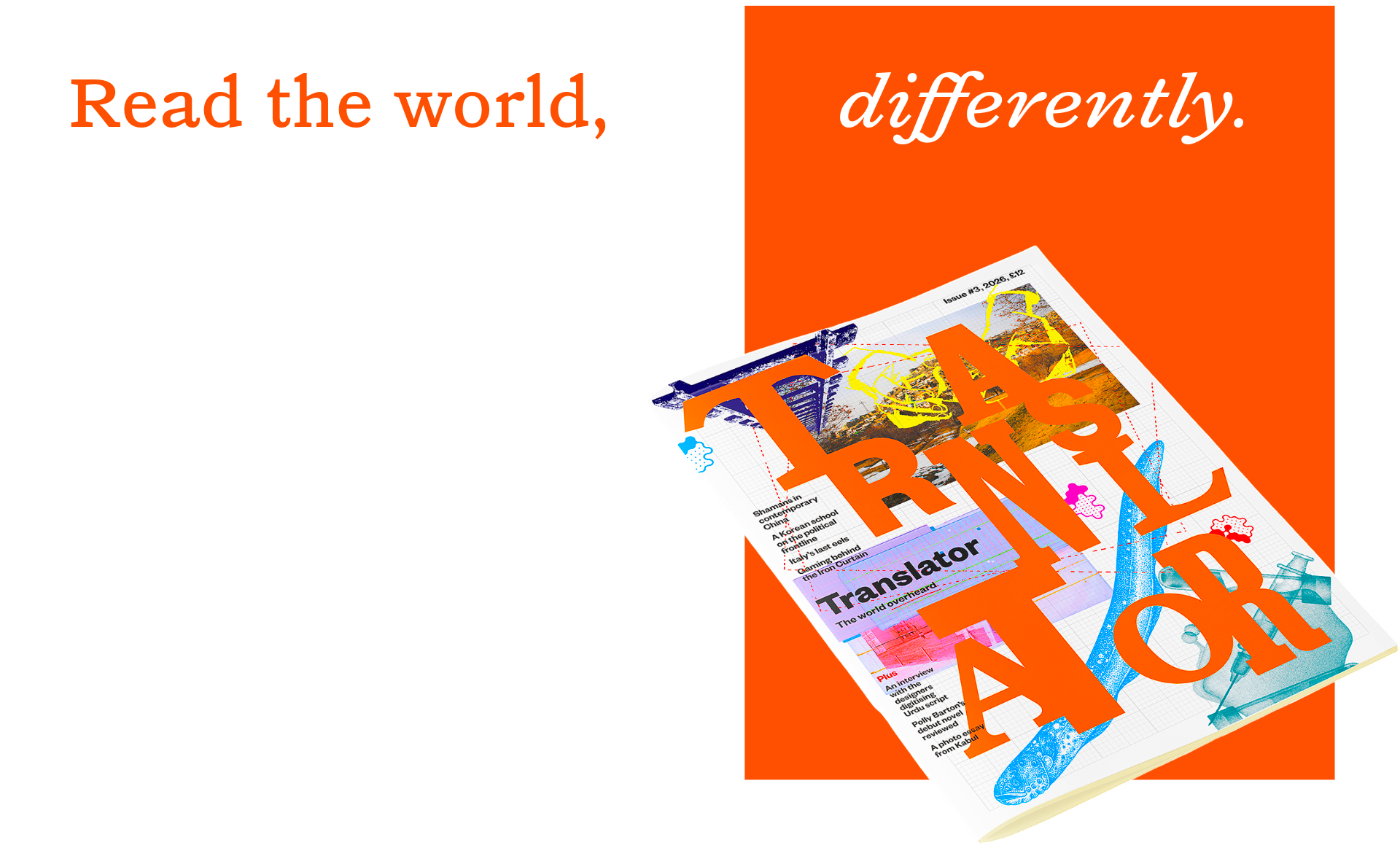
Translator Issue #3 is available now!
Support Translator to continue translating and publishing long-form reportage and journalism from beyond the Anglosphere by purchasing your copy of Issue #3 here.