

Pride Month Dispatch - Guest Edited by Nicole Froio
Read about IVF treatment for lesbian and single women in Spain, the history of Brazil's first gender affirmation surgery, and an uplifting story about a teenager's gender transition.
Every month, Translator invites a journalist working beyond the Anglosphere to guest edit this newsletter by curating and summarising stories from their media landscape. Each selection comes with the guest editor’s own brief insight: why this story matters, how it’s being read locally, and what it reveals about the political, cultural and social forces shaping the moment.
My name is Nicole Froio and I’m a freelance journalist and editor based in Rio de Janeiro, Brazil. I report on gender issues, culture, politics, and technology for publications like Prism Reports, The Verge, Global Voices, The Conversationalist, The Nation and many more. Recently, I’ve written a story about the rise of evangelical women seeking and gaining power in Brazil, a deep dive into AI-generated blackface videos on TikTok, and a feature on how people are pushing back on the United States’ current anti-immigration policies with nail art. I’m also co-founder of a feminist cultural criticism newsletter called The Flytrap, which is an explicitly intersectional feminist publication owned and powered by workers, not Big Tech “bros” and bosses. We seek to keep feminist culture-centered journalism alive at a time when feminist newsrooms are in decline globally.
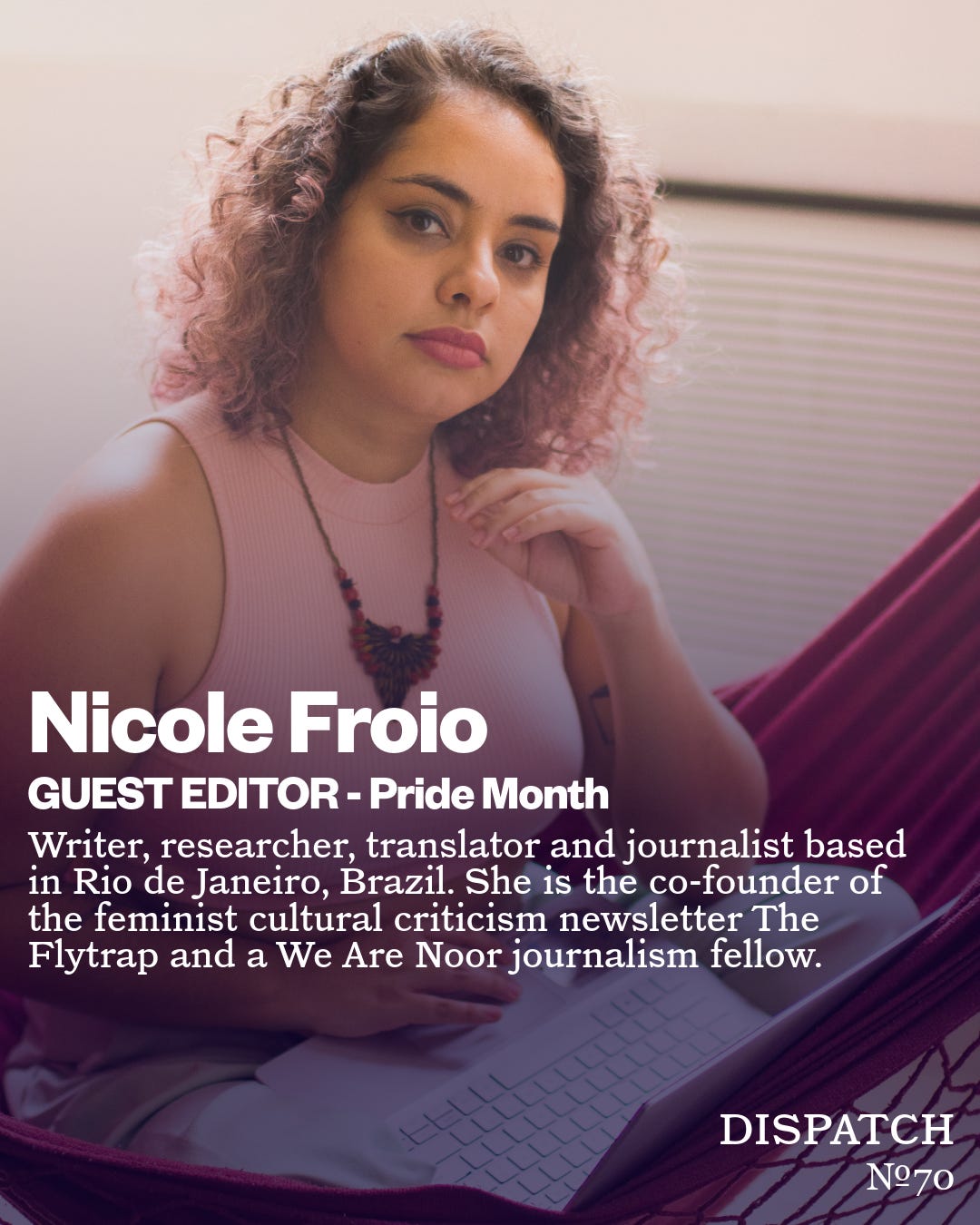
Translation has always been at the core of my work – from translating source quotes, to explaining a cultural concept or word that doesn’t exist in English – and the way communication travels across languages fascinates me. I’m excited to write this special Guest Edit of Translator’s Dispatch, focusing on LGBTQAI+ stories to mark Pride Month, at a time when these rights are under attack globally.
Highlighting stories that centre queer people feels essential to me. A wave of far-right politics is washing over Latin America, as seen in the recent elections of Abelardo de la Espriella in Colombia and Keiko Fujimori in Peru. This shift could spell disaster for the hard-fought rights of queer and other minority groups.
And yet, queer people continue to exist and thrive. The stories I’ve selected below showcase the resistance of queer people in the face of constant attack. May they inspire us to continue fighting for equal rights for all.

How did Spain introduce a policy to provide IVF for all women – regardless of their marital status or sexuality?
The 2016 policy is being replicated across the country, and provides valuable lessons for reproductive healthcare globally
A decade ago, the Health Minister of the Catalan government Toni Comín announced that the public health system of Barcelona, Gerona, Lérida and Tarragona would provide in-vitro fertilization (IVF) for women without male partners. Until then, most single women and lesbian couples had to resort to expensive private healthcare for the treatment.In the public system. heterosexual couples were prioritized. “No matter who wants it, we will answer to the demand,” Comín said at the time. “We are talking about a right.”
Reporting for El País, Rebecca Mouzo delves into the history of this groundbreaking policy, which stemmed from a law passed in the Catalan government in 2014 to guarantee the rights of the LGBTQIA+ community. Mouzo details the political hurdles – from the economic crisis and healthcare cuts under Mariano Rajoy’s government to innovative solutions, such as group visits and improved fertility protocol. These learnings helped the reproductive medicine team at the Puigvert-Hospital Sant Pau Foundation in Barcelona improve the success rate of IVF in single women and lesbian couples from an initial 6 per cent to 20 per cent – in line with the outcomes for heterosexual women and their male partners. The policy has since been replicated across Spain and in 2021, the Ministry of Health published an order guaranteeing access to assisted reproduction within the public healthcare system for women without male partners, as well as transgender people with the capacity to gestate.
To date, Sant Pau-Fundación Puigvert hospital has helped at least 1,700 women conceive over a thousand babies. “It’s a very necessary service,” Victoria Blum, a mother who conceived her daughter Roma through the program, told El País. “I don’t know if I would have been able to try so many times through private healthcare.”

Froio on the selection:
Reproductive rights are under attack in many parts of the world – and single women and lesbian couples still face a number of barriers if they choose to become parents. This story, grounded in data and evidence, shows the impact of a decade of free reproductive health services for all. This policy has genuinely changed the lives of women in Spain and shifted cultural norms around what a family looks like.
Original article published in Spanish as “El plan que levantó el veto a la reproducción asistida a las mujeres solas o lesbianas en la pública: ‘Era una demanda social’” by Jessica Mouzo on 17 June, 2026 in El País.
El País is a major Spanish daily newspaper.

Is it possible to be trans and not suffer so much?
An Argentinian documentary follows a teenager’s transition to answer this question.
The documentary Tristán y los días por venir (Tristán and the days to come) was filmed over seven years, documenting Tristán’s adolescence and gender transition from the age of 14. The film emphasizes that gender transition isn’t something with a neat beginning and definitive ending – it’s an ongoing process with the support of a community and gender-affirming state policies.
Now 22, Tristán tells Argentinian newspaper Clarín: “I feel a lot of nostalgia and tenderness for the person I used to be. I see myself, all small and it makes me want to hug myself and say: ‘Everything will be okay.’”
The piece interviews filmmakers Martina Matzkin and Gabriela Uassouf, who sought to answer the question: is it possible to be trans and not suffer that much? Through Tristán and his family’s story, it was. But it wouldn’t have been possible without a community of people and institutions that are accepting and willing to provide resources for a safe, judgement-free transition.
The point of the film was to make visible a “positive testimony of growth; that it’s possible to be happy, that it’s possible to be surrounded by companionship and love,” Matzkin told Clarín. “Not to erase that there are many cases where this doesn’t happen, but to show the possibility that transitioning can be beautiful, positive, and happy.”

Froio on the selection:
As expressed by the filmmakers, positive gender transition journeys are rare. Often, trans people are blamed for their own tragedies because the world doesn’t want to accept who they are and prefers them to suffer in the closet. It would be easier on both trans people and their families and friends if the world shifted into acceptance and support. This piece demonstrates that love is the path of least resistance, and that hatred of difference makes everything harder.
Original article published in Spanish as “’¿Es posible ser trans sin sufrir tanto?’: el documental que responde esa pregunta” on 9 June, 2026 in Clarín.
Clarín is the largest newspaper in Argentina

Remembering Waldirene Nogueira: a pioneer in sex redesignation in Brazil
Gender-affirming surgery under military dictatorship paved the way for better rights today
Waldirene Nogueira was 26 when she sought gender-affirming surgery in Brazil. It was 1971, the middle of Brazil’s military dictatorship, and plastic surgeon Roberto Farina performed the first-of-its-kind procedure in Oswaldo Cruz Hospital in São Paulo.
Soon after, Farina was sentenced to two years in prison for “grievous bodily harm”. Nogueira unsuccessfully battled her case in courts to change her name and gender descriptors in official documentation, which had previously forced her to use her “dead name” (meaning her name prior to transitioning) for decades. In 1976, she was sent to the Forensic Medical Institute where she was photographed naked and subjected to an invasive gynaecological examination.
Finally, at the age of 65, Nogueira was granted the dignity to change her legal name in her birth certificate and on her national ID card. Her battle for recognition paved the way for trans healthcare in Brazil: since 2018, trans Brazilians can change their names directly in the registry office, without documentation from psychiatrists or judicial orders as previously required.
Froio on the selection:
Can you imagine how scary it was for Nogueira to be a trans pioneer in a country where the military government openly declared LGBTQIA+ people a threat? Nogueira’s bravery and resilience mean that today, trans people in Brazil have an easier time advocating for themselves and their transitioning bodies. Her story is important and more people need to know about it.
Original article published in Portuguese as “Quem foi Waldirene Nogueira, a pioneira da redesignação sexual no Brasil” by Anne Meire Ribeiro and Malu Lucena on 15 June, 2026 for AzMina, by Anne Meire Ribeiro and Malu Lucena.


We’ll be back next week!
The Translator team