

Read Between the Lines #3: On fire in Patagonia
Decoding Argentinian media's coverage of wildfires

Welcome to the third online instalment of Read Between the Lines, where we commission a journalist or commentator to interpret a recent article from beyond the Anglosphere: decoding the article’s meaning in the broader political, cultural and social context in which it was written, helping us understand how it would be read locally and giving us insight into what is making headlines (and why).
In this edition, Argentinian climate journalist Julián Reingold helps us understand what’s missing from wildfire coverage in Argentina’s increasingly hostile media landscape.
But first … we’ve extended the deadline for you to share your feedback and shape the future of Translator for a chance to win a free magazine and tote bag for you and a friend!
We’re also hosting our next free event at Ibraaz in London on 17 June called Translating the Environment – we hope to see you there!

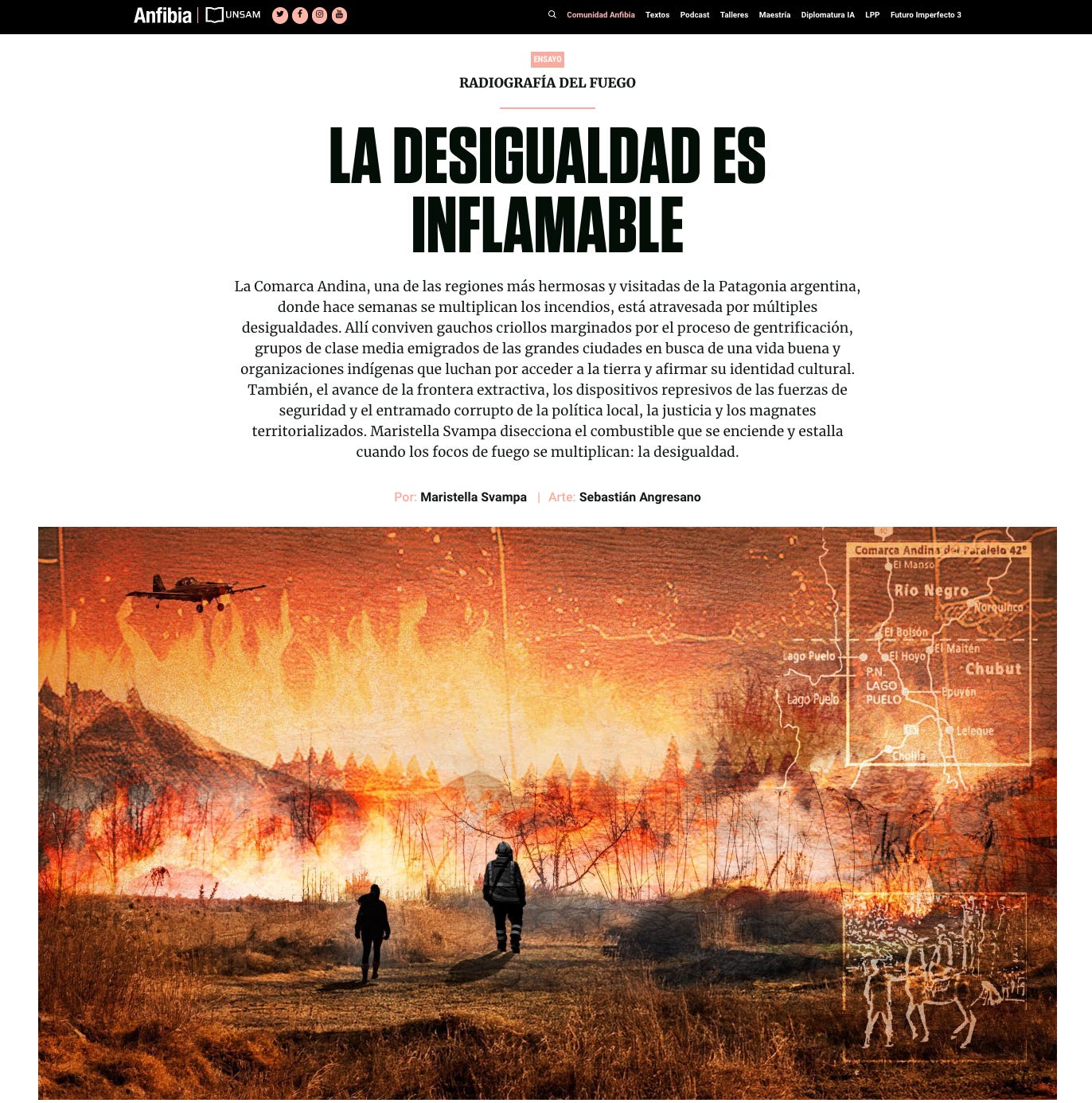

On fire in Patagonia
In early 2026, in the depths of winter in the northern hemisphere, temperatures in the southern hemisphere were peaking. In Argentina, forest fires raged for several weeks in the Andean Region, one of the most beautiful (and most visited) areas of Patagonia.
But these forest fires are not simply a natural disaster. They reflect a changing global climate – the result of human activity over centuries. In Argentina, they have also become a political football. The way they are reported – both in Argentina’s media and beyond it – is itself a reflection both of global debates and local political issues. In a certain sense, the forest fires have taken on an intense symbolic value, almost as intense as the flames themselves.
I chose to write about this topic for Read Between the Lines starting with an essay published on January 12, 2026 in Anfibia Magazine – an independent news outlet from Argentina – in which sociologist Maristella Svampa explains how climate change worsens inequality, and how President Javier Milei’s far-right ideology and climate denialism has made the situation much worse.
Svampa begins by describing the idyllic mountain town of Epuyén in Chubut as among the worst hit by the January wildfires.
“Hippies viejos, llegados hace décadas, que todavía incursionan en las ferias de artesanos, permacultores y ambientalistas de nuevo cuño, jóvenes de todo el país en busca de otros horizontes, se instalaron en pequeñas chacras, dedicadas a la agroecología o a los cultivos orgánicos. Hoy se codean con comunidades indígenas originarias que disputan orgullosas la tierra, y con criollos de campo, de boina, que andan a caballo y sufren parte del desplazamiento que propone la gentrificación creciente. La Comarca es también ahora un territorio donde desembarcaron grandes empresarios turísticos y forestales […] Pero, lejos de ser un lugar idílico, la convivencia entre los diferentes grupos sociales que habitan la Comarca Andina no es armoniosa.”
“Old hippies, who arrived decades ago and still frequent artisan fairs, along with newly minted permaculture and environmentalists, and young people from all over the country seeking new horizons, have settled on small farms dedicated to agroecology or organic farming. Today, they coexist with Indigenous communities who proudly defend their land, and with traditional farmers, wearing berets, who ride horses and are experiencing some of the displacement brought about by increasing gentrification. The region is also now a territory where large tourism and forestry companies have established themselves […] But coexistence among the different social groups inhabiting the Andean Region is far from harmonious.”
Svampa goes on to describe the dramatic consequences of deforestation and the replacement of native trees with exotic species in Epuyén’s surrounding forests since the 1970s. Species like the radiata pine from the Northern Hemisphere are invading the land as the native forest recedes and centuries-old species such as coihue, lenga, notro, and maiten trees are lost. These plantations are now at a stage of extreme maturity, but thanks to Milei’s heavy cuts to the forestry department since taking office in 2023, there is no management of abandoned forests. Instead, they have become a literal tinderbox for the raging fires.
Another key factor affecting the Patagonian region is a virulent campaign against Indigenous people and their rights, in the context of land disputes and the advance of oil and mining extraction, dams, and mega-tourism projects across the country.
The fires have become a lightning rod, politicised by both sides of the political debate, used to score political points and scapegoat adversaries. As Svampa writes:
“ … con la llegada del ultra-neoliberal Javier Milei, y el regreso de Patricia Bullrich en el Ministerio de Seguridad Nacional (estuvo a cargo de dicho ministerio durante la gestión del PRO y fue responsable de los operativos que terminaron con la vida de Santiago Maldonado y Rafael Nahuel), el racismo anti-mapuche volvió a encenderse a niveles delirantes.”
“ … With the arrival of the ultra-neoliberal Javier Milei, and the return of Patricia Bullrich to the Ministry of National Security (responsible for the operations that resulted in the deaths of activist Santiago Maldonado and Indigenous leader Rafael Nahuel), anti-Mapuche racism has reignited to delirious levels.”
In times of multiple crises, with an absentee state and all kinds of denialism running rife, Svampa suggests the media and the government’s response is to find a scapegoat, namely an “internal enemy”, inevitably found among the most vulnerable sectors of society.
This becomes clear in the ways in which fires have been politicised by both right and left-leaning media outlets in Argentina. For example, the progressive newspaper Página 12 reported on an incident where two tourists started a bonfire inside a protected national park in Santa Cruz. Unverified claims that they were Israeli were widely shared on social media and by Argentina’s opposition. Meanwhile, La Derecha Diario, a far-right online outlet aligned with the government, quoted a statement released by the Ministry of Security pointing to the possible involvement of Indigenous Mapuche groups supposedly seeking to use fire as a tool of political pressure and destabilisation.
Argentinian media often pursues a click-bait approach to news stories that works well in such a polarised society as ours, pointing the finger at irresponsible tourists or Indigenous groups to stir up public debate. But they don’t tend to go much deeper into the main cause of the devastation: climate change.
Take Infobae – one of the most-read news outlets in the Spanish language. Despite having scientific journalists among its staff, their coverage contains only a mild criticism of Milei’s budgetary cuts for wildfire prevention and a shy paragraph pointing towards the government’s share of responsibility.
Meanwhile, La Nación, Argentina’s leading conservative newspaper, didn’t send a reporter to cover the wildfires and opted instead to republish a wire piece from the Associated Press.
In contrast, international media covering Argentina’s forest fires went far deeper.
The Spanish-language version of National Geographic explained how the involvement of residents in fighting the fire was due to the lack of a coordinated state response and that the Epuyén firefighters’ annual budget was only enough to buy two firefighter suits after Milei’s cuts.
French news outlet France24 mentioned the emergence of “fifth and sixth generation” fires: those with multiple fronts, extreme behaviour, and firestorms that overwhelm any capacity for control.
Spain’s El País noted that these are the worst fires of the last decade, with more than 55,000 hectares of land consumed – an area almost the size of the city of Madrid – and pointed to the operational fragility of those tasked with getting the fires under control. It also detailed how the water bombers' flight hours were cut dramatically since Milei took office.
Mongabay Latam quoted a new analysis by the scientific organisation World Weather Attribution which concludes that the extreme weather events that accompanied the fires were up to three times more likely due to global warming caused by the burning of fossil fuels.
Finally, Germany’s DW explained that the national government was finally forced to respond after the governors from the Río Negro and Santa Cruz provinces demanded it.
But all is not lost: an anonymous article by the Argentinian outlet La Política Online pushed for further accountability. It listed three of Milei’s decisions that worsened the Patagonia fires: choosing someone with no experience in natural resource conservation as director of Argentina’s 39 national parks; the deactivation of the Unified Command project planned to combat forest fires in Patagonia; and finally, an ideological refusal to acknowledge the role of climate change itself.
I asked environmental experts for their take on the Argentinian media’s failure to properly cover the wildfires. Bariloche-based climate activist Sofia Nemenmann said:
“In the climate crisis context, things are only going to worsen – we will not be able to avoid future fires, but we’ll try to contain them. However, we face an uphill road if the media refuses to mention the climate factor to comply with the government’s anti-science approach. Park rangers have lost their jobs just by mentioning climate change as a driver of fire.”
Sergio Federovisky, former vice-minister for the environment under President Alberto Fernandez (2019-2023), said:
“[Public] debate [in Argentina] is centered on whether Mapuche Indigenous people or Israeli tourists started the fires, which is why the response strategy is misguided: eight out of ten emergencies in Argentina are related to environmental issues, exacerbated by climate change. Therefore, the strategic focus must be on the environment, given that a changing climate requires long-term public policies and investment, and that is not something that Milei is willing to accept.”
I also spoke to Marc Castellnou, one of the world’s leading wildfire analysts. He told me that the 2026 fires are an evolution of what he saw in 2021 and 2024 in Patagonia, and that other countries in the Mediterranean, Canada, and the US state of California face similar challenges. Without effective strategies based on the realities of how climate change is playing out, he says, firefighters will always be playing catch-up.
There is a tiny silver lining in this. The wildfires in Argentina helped fine-tune the AI engines of fire monitors in the Northern Hemisphere. Castellnou is currently working with the Meteorology and Air Quality research group at the University of Wageningen in the Netherlands to estimate the behaviour of future fires, including their type, size and intensity.
In Argentina, there has never been any discussion about how to adapt land-use planning to what climate change dictates. As extreme temperatures and natural disasters are set to become the new normal in Argentina and elsewhere, vulnerable communities like those in Epuyén will continue to bear the brunt.
Indeed, they are already facing new and urgent threats: the recent modification of the Glaciers Law will greenlight major new open-pit mining projects in periglacial areas that supply water needed for, among other things, putting out fires in Patagonia. Milei’s libertarian government also wants to repeal the Rural Lands Law, which prohibits foreign individuals or legal entities from acquiring rural lands that contain bodies of water, which are essential for firefighters in cases of environmental emergency.
Without much-needed interventions, we will see this same cycle of media coverage and disaster response strategy (or lack thereof) repeat itself.

The original article ‘La desigualdad es inflamable’ by Maristella Svampa was published in Spanish for Anfibia on January 12, 2026.

Thanks for reading, we hope you learned something new.
A reminder to please share your feedback on Translator’s coverage for a chance to win a free magazine and a tote bag for you and a friend.
We hope to also see those of you in London on June 17 for our next event!
– The Translator team